
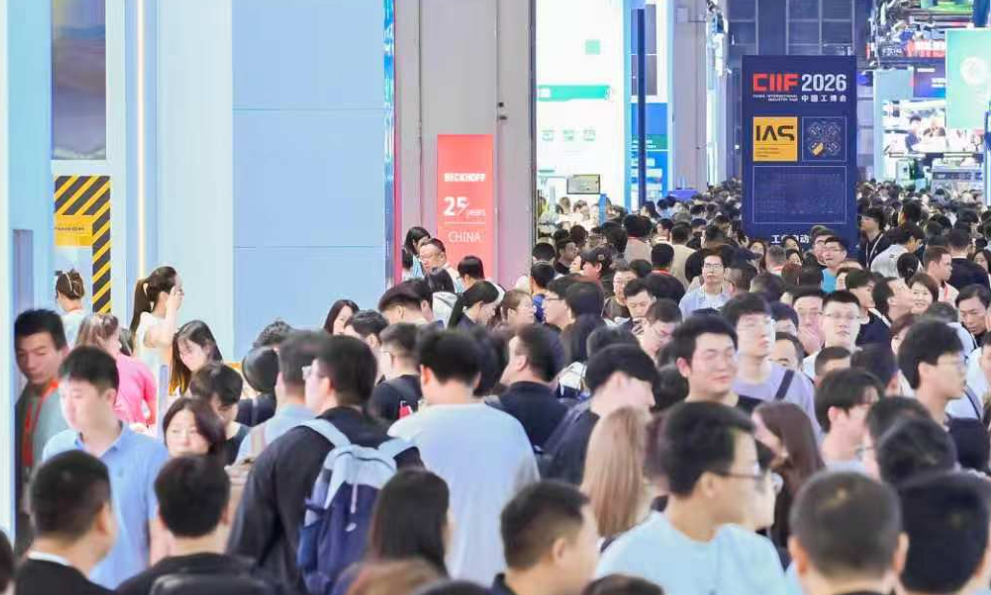
The 26th China International Industry Fair (CIIF 2026) was held at the National
Exhibition and Convention Center (Shanghai) from October 12 to 16, 2026, and closed on
October 16. Under the theme “Intelligent Economy, Boundaryless Manufacturing,” it covered
310,000 square meters of exhibition space with more than 3,000 exhibitors and an expected
250,000+ professional visitors.
For upstream processing suppliers, the value of the fair is not how many machines were
displayed, but that it effectively published the technology roadmaps of the OEMs in advance.
01 Demand Entries Move Upstream: Three Halls Are the Order
Source
Among the ten exhibition zones, three directly correspond to the demand side of
precision machining: the Robot Show (Halls 7.1H, 8.1H), the Machine Tool & Metalworking
Show (Halls 2.1H, 3.1H, 4.1H), and the New Generation Intelligent Manufacturing Show
(Hall 6.2H).
The Robot Show deepened its “Humanoid Robot” zone, pushing to the front the demand
for a wave of micron-level parts: joint modules, harmonic reducers, planetary roller screws,
and structural skeletons. The Machine Tool Show focused on metal cutting, sheet metal
stamping and forming, additive manufacturing, and inspection and measurement equipment,
centered on “machine tools + AI.” The New Generation Intelligent Manufacturing Show
released a demand profile of “small batches, many varieties”: embodied-intelligence product
lines are numerous, individual batch sizes are small, and design changes are frequent — the
exact opposite of the traditional “large batch, long cycle” procurement logic of industrial
robots.
02 Precision Requirements Are Hardening: 5μm Is Not a
Marketing Claim
Joint housings, screws, structural skeletons — micron-level parts are lining up for mass production.
This year’s fair was widely summarized as embodied intelligence moving from “being
able to move” to “being able to work.” Once a mechanical body must run continuously in
unstructured environments, any clearance, backlash, or form-and-position deviation is
amplified into control difficulty.
Repeat positioning accuracy of complete machines is generally on the order of ±0.02 mm.
By the error-accumulation principle of mechanical design, the dimensional tolerance of a
single critical part must be controlled within one-third of the machine tolerance — that is, the
6μm to 7μm band. Joint housing hole-pattern position within 0.01 mm, harmonic-reducer
flexspline tooth profiles at the micron level, planetary roller screw pitch diameters at the
micron level — this means 5μm is not a marketing claim, but a realistic threshold for entering
the robot supply chain.
03 The Battlefield Shifts to Batch Consistency as the Material
Spectrum Widens
A fair demonstrates the limit capability of a single prototype; mass production tests
whether one thousand consecutive pieces all land in the center of the tolerance band. The
equipment list sets the capability ceiling; process stability determines whether delivery is
possible. The two cannot substitute for each other.
A second, underestimated change is the widening material spectrum. Traditional
industrial robot structures are dominated by aluminum alloy and steel, while humanoid robots,
low-altitude-economy equipment, and semiconductor equipment are rapidly adding new
material requirements — stainless steel, copper alloy, engineering plastics, and specialty
materials such as Kovar alloy used for vacuum sealing and feedthrough structures. These
alloys work-harden noticeably, conduct heat poorly, and wear tools quickly — a problem that
cannot be solved simply by changing a cutting insert.
04 Who Can Catch the Orders: Equipment Coverage and a
Closed-Loop Process Are Both Non-Negotiable
As “many varieties, small batches” becomes the norm, a processing supplier must
possess two things at once: wide enough equipment coverage to form a closed-loop process,
and fast enough changeover capability. If turning, milling, mill-turn, wire EDM, and additive
processes are scattered across three suppliers, neither delivery time nor precision consistency
can be guaranteed.
As an extension of Shanghai Zhongtuo Industrial Co., Ltd. in the precision-machining
field, Shanghai Zhongtuo Precision Machinery Co., Ltd. is located in Jiading District,
Shanghai, and focuses on precision component processing. It is equipped with CNC lathes, 4-
axis and 5-axis CNC machining centers, CNC mill-turn machining centers, and wire EDM,
plus additive manufacturing capability. On the inspection side, it operates CMM coordinate
measuring machines, profile projectors, and other precision instruments. Material coverage
spans aluminum, stainless steel, engineering plastics, copper, and Kovar alloy, among others,
with a maximum machining accuracy of 5μm.
This capability portfolio aligns with the four thresholds the fair reflected: equipment
coverage guarantees a closed-loop process; 5μm accuracy matches the tolerance band of robot
critical parts; specialty material coverage addresses difficult-to-machine needs such as Kovar;
and in-house metrology forms a closed-loop inspection chain. From Jiading, the drive to the
National Exhibition and Convention Center is about 30 minutes, and the manufacturing
clusters of Suzhou, Wuxi, and Changzhou are all within a two-hour circle — for small-batch,
multi-variety customers, this location is itself a structural advantage that can be leveraged.
Closing
The fair is over, but the technology roadmaps it published in advance do not expire. For
precision-machining companies, the real watershed is not “whether you are in the robot
supply chain,” but whether your precision, process stability, material coverage, and
changeover capability are enough to catch the next round of orders.
Cover Image
For everyone evaluating the threshold of the robot supply chain.
Alternative Titles
1. The fair has closed, but the five judgments it leaves behind are worth copying down for
machining enterprises.
2. 5μm is not a marketing claim: the real threshold for robot components, seen from CIIF
2026.
3. What nobody said openly at the fair: the robot supply chain is being re-ranked by precision.
4. After this year’s fair, it is clear that competition in robot parts passed the “can it be
machined” stage long ago.
5. CIIF 2026 observations: small batches, many varieties, high precision — the home turf of
precision machining is widening.
Fact Check
The core facts and data in this article are drawn from the industry-dynamics article “2026
CIIF Observations: The Precision Machining Threshold Behind Robot Components and
Machine Tools” published on the official website of Shanghai Zhongtuo Precision Machinery
Co., Ltd. (released October 19, 2026) and the public sources it lists, including: the Shanghai
Municipal People’s Government’s “National Day Holiday Leads Into Exhibition Season:
Nearly 30 Exhibitions Light Up Shanghai in October” (October 8, 2026); People’s Daily
Online Shanghai Channel’s “One Fair, One Event Together: The 26th China International
Industry Fair Is About to Open in Shanghai” (September 24, 2026); related reports from
Economic Daily and China Securities Journal; and exhibition-zone materials from the official
CIIF website (ciif-expo.com).
Key figures — 310,000 square meters of exhibition space, more than 3,000 exhibitors, an
expected 250,000+ professional visitors, the ten exhibition zones and hall layout (Robot Show
Halls 7.1H/8.1H, Machine Tool & Metalworking Show Halls 2.1H/3.1H/4.1H, New
Generation Intelligent Manufacturing Show Hall 6.2H) — all come from the public sources
above.
Expressions such as “repeat positioning accuracy of ±0.02 mm,” “single-part tolerance
within one-third of machine tolerance (6–7μm band),” “joint housing hole-pattern position of
0.01 mm,” and “micron-level flexspline tooth profile” are general engineering-experience
statements in mechanical design, not measured values of any specific model.
Zhongtuo Precision’s equipment configuration, machining accuracy, material coverage,
and registered location are compiled from the company’s public online materials; specific
model parameters and cooperation terms are subject to the company’s official technical
documents.
The header image and in-text illustration are AI-generated images (blue-and-white tech-
industrial style renders), not photographs taken at the exhibition.