
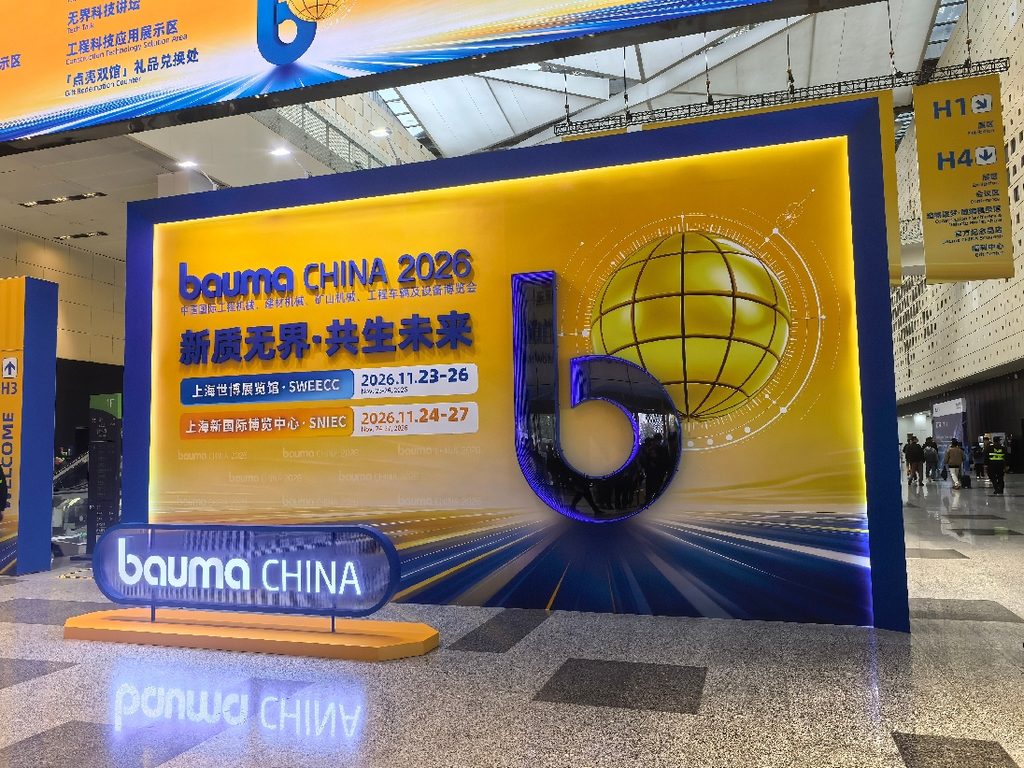
Date: 23 November 2026 Venue: Shanghai World Expo Exhibition & Convention Center. This year adopts a dual-venue setup for the first time: Expo Center (23–26 Nov) and Shanghai New International Expo Centre (SNIEC, 24–27 Nov). Theme: New Quality, Boundless Innovation · Co-Creating the Future
1. Overview of Day 1
The first day marked the official opening of bauma CHINA. Only the World Expo Exhibition & Convention Center was open on this day, featuring cutting-edge smart technologies, new-energy equipment, digital solutions, low-carbon eco-systems, on-site live demonstrations and industry forums. The SNIEC showcases large complete machines, earthmoving & mining equipment, hydraulic transmission components and other products, opening the next day. A single ticket grants access to both venues, with shuttle buses in service. The total exhibition area reaches 400,000 m², hosting 4,120 exhibitors from more than 30 countries and regions, hitting a new record in scale.
Heavy foot traffic was seen on opening day. Visitors were mainly R&D, procurement staff from OEMs, overseas distributors and component suppliers, as well as clients from mining and general contracting sectors. The parallel Construction Machinery Innovation Summit covered topics including AI foundation models, smart mines, digital twins and zero-carbon construction.
2. Key Highlights & Industry Technology Trends
2.1 Electrification evolves from standalone units to full-scenario integrated packages, with a maturing power ecosystem
Electrification is no longer a simple replacement of combustion engines. Integrated solutions combine complete machines, dedicated construction machinery batteries, charging/swapping infrastructure and thermal management systems:
- Leading OEMs have sharply raised the share of new-energy models: Sany’s electrification ratio exceeds 80%; XCMG’s new-energy exhibits account for over 70%; LiuGong’s non-fuel models reach 88%. The portfolio covers excavators, loaders, mining trucks, aerial work platforms, road rollers and other categories.
- CATL, EVE Energy and REPT Battery display custom-built batteries for construction machinery, optimized for heavy-load, low-temperature and high-intensity working conditions. Refueling alternatives such as fast charging, battery swapping and supporting energy storage systems are core focuses for supporting suppliers.
- Hybrid and hydrogen-powered machines continue to be developed, serving differentiated scenarios including overseas markets with varying emission regulations, enclosed mining zones and low-noise urban municipal construction.
2.2 AI and unmanned operation, embodied intelligence stand out this year – moving from demos to coordinated site operation
The Expo venue featured three real-scenario showcases: unmanned mines, smart factories and green intelligent construction:
- Unmanned mining trucks, loaders and rollers support cluster collaborative operation under cloud-based dispatching, forming a closed loop of excavation, haulage and dumping. Horizon Robotics demonstrated new national-standard autonomous heavy trucks; Easy Control Auto’s mine autonomous driving solutions were on display, targeting mixed-traffic deployment in mines, ports and industrial parks.
- Zoomlion exhibited bipedal humanoid robots and an embodied intelligence module. Sany launched an AI agent and a heavy-duty robot base. Bosch Rexroth, Wika and others rolled out large-model-enabled controllers and intelligent electronic control systems, enabling equipment to perceive surroundings, predict faults and self-optimize parameters.
- Remote control, 5G digital twins and AR maintenance demos are widely presented, addressing pain points such as hazardous-site labor replacement and long-distance construction supervision.
2.3 Shifting competition logic: selling standalone machines gives way to delivering end-to-end construction solutions
Many enterprises are no longer launching equipment separately. Instead, they offer packaged solutions tailored for mines, road projects, ports and new-energy infrastructure, bundled with digital management platforms, aftermarket maintenance and localized overseas services. These cater to major domestic projects and global export demands. International brands (Caterpillar, Komatsu, Wirtgen etc.) focus on localized electrification and intelligent retrofitting. Clear divergence exists between Chinese and foreign technical routes: domestic players advance faster and adopt bolder scenario deployment, while global brands prioritize reliability, compliance frameworks and global spare-parts networks.
2.4 Accelerated domestic substitution of components and control supply chains
Domestic suppliers of hydraulics, electronic control, sensors and on-board computing platforms gathered at the show, co-developing products alongside OEMs. Energy-saving hydraulic systems, lightweight structures and high-voltage electrical systems are key R&D directions for component vendors. Supply chain autonomy remains a core strategy for most machine manufacturers.
3. Business & Market Observations
- Overseas expansion is a universal priority: A large number of exhibits are customized to meet regulations in Europe, America, Southeast Asia, Central Asia and Africa. Many brands rolled out export-specific electric equipment. Overseas buyers showed strong on-site engagement.
- Shifting customer priorities: Buyers care less about upfront purchase prices, and focus more on energy consumption data, battery cycle life, maintenance costs, real operational efficiency of unmanned systems, after-sales service networks and spare-part lead times.
- High-potential segments: Aerial work platforms, unmanned mining equipment, compact electric municipal machinery and special construction robots attracted strong interest.
- Existing challenges: Electric equipment carries high initial acquisition costs; battery residual-value recycling systems remain immature; unmanned systems still need stability improvements in complex unstructured worksites.
4. Takeaways & Follow-up Plans from This Visit
Key Takeaways
- Clear visibility of industry megatrends: electrification, AI-enabled unmanned operation, solution-based offerings, decarbonization and globalization. The Expo venue showcases forward-looking technologies, ideal for benchmarking cutting-edge solutions and connecting with battery, electronic control and autonomous driving suppliers.
- Collected new-product roadmaps, specifications and site solutions from leading manufacturers, for benchmarking technical gaps between domestic and international players.
- Established contacts with suppliers of power batteries, ECUs and autonomous driving systems, gaining insights into supply chain maturity and price ranges.
- Captured genuine client demands: cost reduction, manpower reduction, regulatory compliance and full-lifecycle maintenance.
Next Steps
- Visit the SNIEC on 24 November, focusing on large mining & earthmoving machines and core hydraulic transmission components.
- Follow up with interested suppliers and channel partners, and organize sample-machine and solution documentation.
- Deliver an internal benchmarking analysis covering product roadmaps, cost structures, differentiation opportunities and risk factors.
5. Summary
Day 1 at the Expo venue demonstrated the transformation of construction machinery from traditional hardware into heavy-duty intelligent robots paired with energy systems and digital platforms. New-quality productivity is no longer a buzzword; it has been deployed at scale in real mine and construction scenarios. A clear industry watershed has emerged. Companies relying solely on hardware sales face mounting competitive pressure. Enterprises capable of delivering scenario-based solutions, intelligent dispatching, supporting energy infrastructure and global services will hold stronger competitive advantages.